
Agentic AI: Why Autonomous Agents Are Becoming the New Operating Layer for Business
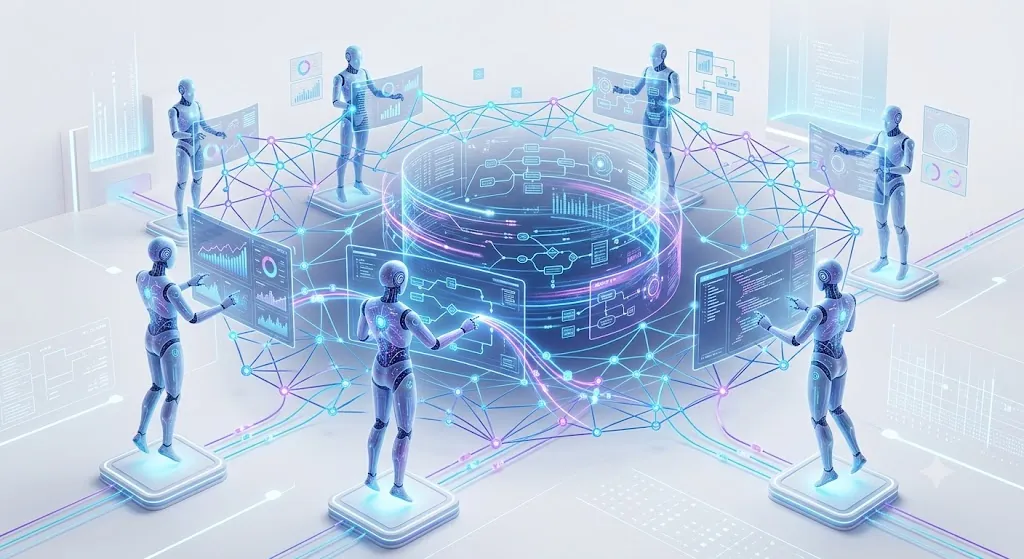
Agentic AI marks a shift from AI that answers questions to AI that completes work. Instead of waiting for a prompt and returning a single response, an AI agent can plan a sequence of steps, call tools and APIs, check its own output, and keep working toward a goal with minimal supervision. For businesses, this changes the question from “what can AI tell us?” to “what can AI actually do for us?”
This guide explains what agentic AI is, how it differs from the chatbots and copilots most teams already use, the architecture patterns behind real agent systems, where agents are creating measurable value today, and the governance practices that keep autonomous systems safe and accountable.
What Is Agentic AI?
An AI agent is a system built around a language model that can reason about a goal, break it into steps, choose and use tools, observe the results, and decide what to do next — repeating that loop until the goal is met or a limit is reached. The defining feature is the loop: plan, act, observe, adjust.
This is different from a single-turn AI interaction, where a model receives one input and produces one output with no further action. An agent might receive a single instruction — “reconcile this month's invoices against the purchase orders” — and then independently open files, run comparisons, flag discrepancies, draft a summary, and send it for review, all without a human directing each step.
Agents vs. Chatbots: The Key Difference
Conversational AI tools are reactive — a person asks, the model answers, and the interaction ends unless the person continues it. Every step requires human input. This works well for drafting, summarising, and answering questions, but it does not remove people from repetitive multi-step processes.
Agentic systems are proactive within a defined scope. Once given a goal and the tools to act on it, an agent continues working across multiple steps — checking a database, calling an API, updating a record, sending a notification — without a person re-prompting it at each stage. The human's role shifts from operator to supervisor: setting the goal, defining the boundaries, and reviewing the outcome.
How AI Agents Are Built: Tools, Memory & Planning
Most production agent systems share three components. Tools give the agent the ability to act — calling internal APIs, querying databases, sending emails, updating tickets, or running code. Memory lets the agent retain context across steps and sessions, so it doesn't lose track of what it has already done or learned. Planning is the reasoning layer that breaks a goal into an ordered sequence of steps and adapts that sequence as new information arrives.
The quality of an agent system depends less on the underlying model and more on how well these three components are designed. A well-scoped toolset with clear permissions, a memory system that retains the right context without becoming unreliable, and a planning approach that fails safely when it hits an unexpected situation — these are the engineering decisions that determine whether an agent is useful or risky.
Where Agentic AI Is Already Delivering Value
The clearest early wins are in operationally repetitive, well-documented processes: IT support triage that diagnoses common issues and applies fixes automatically, finance workflows that reconcile records and flag exceptions for human review, sales operations that research leads and draft personalised outreach, and DevOps agents that monitor systems and respond to routine alerts.
What these use cases have in common is that the process is well-understood, the tools the agent needs already exist as APIs, and the cost of an occasional mistake is low and recoverable. Organisations that start in these areas build confidence — and the operational scaffolding — needed before extending agents into higher-stakes processes.
Multi-Agent Systems & Orchestration
More complex problems are increasingly handled not by a single agent but by a team of specialised agents, each responsible for part of the task and coordinated by an orchestrator. A research agent might gather information, a drafting agent produces content, a review agent checks it against a style guide, and a coordinator decides when the output is ready to hand to a human.
This division of labour mirrors how human teams operate, and it has practical benefits: each agent can be given a narrower, better-defined role with fewer tools and tighter permissions, which makes the overall system easier to monitor, debug, and constrain than one agent trying to do everything.
Risks: Reliability, Cost & Runaway Actions
Because agents take multiple steps autonomously, errors can compound. A misread instruction at step one can lead an agent confidently down the wrong path for the next ten steps before anyone notices. Cost is also a real consideration — agents that loop, retry, or call expensive tools repeatedly can run up significant compute and API costs without producing useful output.
The most serious risk category is irreversible or high-impact actions taken without adequate checks: sending an email to the wrong recipient, modifying production data, or executing a financial transaction based on a flawed plan. These are the scenarios that make scoping, permissions, and human checkpoints non-negotiable for any agent with access to real systems.
Governance & Human-in-the-Loop Design
Effective agent governance starts with scope: defining precisely what an agent is allowed to do, which tools it can access, and what actions require human approval before execution. Logging every decision and action an agent takes creates an audit trail that makes it possible to understand what happened when something goes wrong — and to improve the system over time.
Human-in-the-loop checkpoints should be placed at the points of highest consequence, not at every step — otherwise the agent provides little efficiency gain. A practical pattern is to let agents act freely within a low-risk sandbox, and require explicit approval before any action that touches money, customer data, or external communications.
A Practical Adoption Path for Agentic AI
Organisations that succeed with agentic AI tend to start narrow: pick one well-documented, medium-frequency process with clear success criteria, build an agent with a small toolset and tight permissions, and run it alongside the existing human process for a period before fully automating it. This builds both technical confidence and organisational trust.
From there, expansion happens incrementally — adding tools, widening scope, or introducing additional agents into an orchestrated workflow — always with logging, monitoring, and human checkpoints carried forward. The goal is not to remove people from the process, but to remove the repetitive steps that don't require human judgment.
The Future: Agents as Default Software
As agent frameworks mature and tool ecosystems become more standardised, the distinction between “an application” and “an agent that uses applications” is likely to blur. Business software is increasingly being built with agent access in mind from the start — exposing clean APIs and structured data specifically so that agents (as well as humans) can use them.
The organisations best positioned for this shift are those building the operational discipline now: clear documentation of processes, well-structured APIs, and governance frameworks for autonomous systems. These are the same foundations that make agentic AI safe — and they are valuable regardless of how quickly agent adoption accelerates.
Conclusion
Agentic AI represents a genuine step change from AI that talks to AI that does — but the gains depend entirely on how well the agent is scoped, governed, and monitored. The organisations getting real value are not the ones with the most ambitious agents; they are the ones that started narrow, built trust through transparency and logging, and expanded deliberately.
If you're evaluating where agentic AI fits in your operations, the starting point is identifying a well-documented, repetitive process with clear success criteria and low-risk failure modes — and building from there with the governance practices that keep autonomy accountable.
Ready to explore AI automation for your business?
AtomLeap.ai designs and deploys practical AI workflow systems — built around your existing tools, processes, and operational requirements.
Book a discovery callRelated Articles

Software Development
AI-Assisted Software Development: A Practical Guide for Engineering Teams
How AI coding assistants, automated review, and test generation are changing the developer workflow — and where human judgment still matters.

Cloud & Infrastructure
Cloud Computing & Cloud-Native Technologies: The Foundation for Modern AI Workloads
Containers, Kubernetes, serverless, and multi-cloud strategy — the infrastructure decisions that determine whether AI workloads scale reliably.

AI & Machine Learning
Generative AI & Large Language Models: A Complete Business Guide
How LLMs work, where they’re reshaping business operations, and what teams need to understand before building with them.