
Cloud Computing & Cloud-Native Technologies: The Foundation for Modern AI Workloads
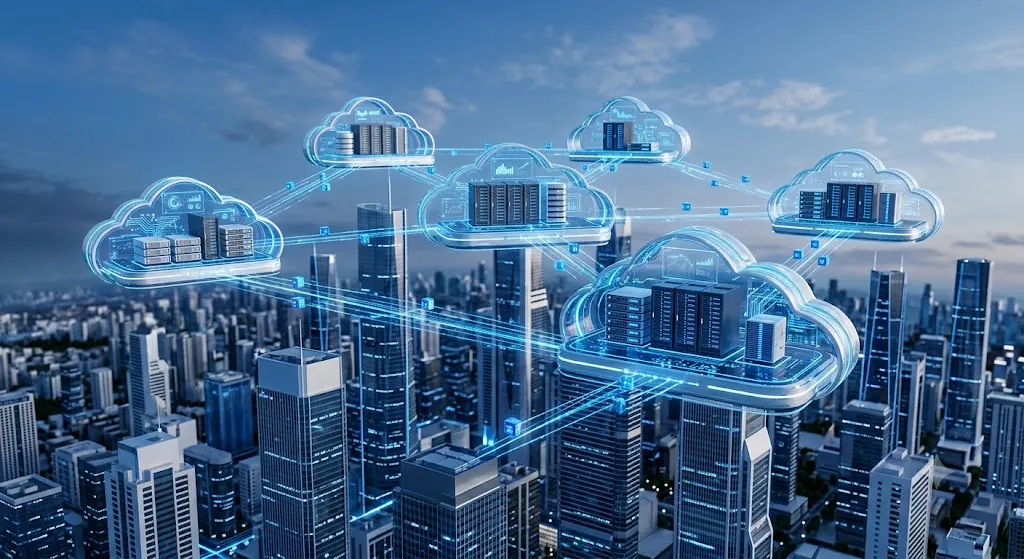
Every AI capability discussed in boardrooms today — generative AI assistants, autonomous agents, real-time analytics — runs on infrastructure. Cloud computing and cloud-native architecture are the foundation that determines whether those capabilities scale reliably, cost-effectively, and securely, or whether they become expensive, fragile experiments that never make it past a pilot.
This guide covers the shift to cloud-native architecture, the core technologies — containers, Kubernetes, serverless computing — that make it possible, what's specifically required to support AI and ML workloads, and the cost, security, and reliability practices that determine whether cloud infrastructure is an enabler or a liability.
The Shift to Cloud-Native Architecture
Cloud-native refers to building and running applications designed specifically to take advantage of cloud computing's strengths: elasticity (scaling resources up and down based on demand), resilience (designing for failure rather than assuming it won't happen), and portability (running consistently across different environments). This is a different mindset from simply moving an existing application onto cloud servers.
Organisations that have made this shift typically structure applications as a collection of smaller, independently deployable services rather than a single large application, use automated infrastructure management rather than manual server configuration, and design systems that can recover automatically from individual component failures rather than requiring manual intervention.
Containers, Kubernetes & Microservices
Containers package an application together with everything it needs to run — code, dependencies, configuration — into a single unit that runs consistently regardless of the underlying infrastructure. This solves the long-standing “it works on my machine” problem and makes it practical to run many independent services on shared infrastructure efficiently.
Kubernetes has become the standard system for managing containers at scale — automatically deploying them, restarting failed ones, distributing load across available resources, and scaling the number of running instances based on demand. This pairing of containers and Kubernetes underlies the microservices architecture pattern, where an application is built from many small, independently deployable services rather than one large codebase.
Serverless & Event-Driven Computing
Serverless computing takes the abstraction a step further — instead of managing containers or servers at all, developers write functions that run in response to events (a file upload, an API request, a scheduled time) and the cloud provider handles all the underlying infrastructure, scaling automatically from zero to handle whatever load arrives.
This model is particularly well-suited to workloads that are intermittent or unpredictable — where running dedicated infrastructure around the clock would be wasteful. Event-driven architectures, where services communicate by publishing and responding to events rather than direct calls, complement serverless computing and are increasingly common in systems that need to react to data as it arrives, including many AI pipelines.
Cloud Infrastructure for AI & ML Workloads
AI and machine learning workloads have infrastructure requirements that differ significantly from typical web applications — particularly around specialised hardware (GPUs and other accelerators), large-scale data storage and movement, and the ability to run training jobs that may take hours or days followed by inference workloads that need to respond in milliseconds.
Cloud platforms have built extensive services specifically for AI workloads: managed environments for training and deploying models, access to specialised hardware without large capital investment, and tools for managing the data pipelines that feed AI systems. For most organisations building AI capabilities, cloud infrastructure isn't just convenient — it's the only practical way to access the hardware and scale required, especially for workloads that are intermittent rather than constant.
Multi-Cloud & Hybrid Cloud Strategy
Many organisations run workloads across multiple cloud providers, or combine cloud infrastructure with on-premises systems — for reasons including avoiding dependency on a single vendor, taking advantage of specific capabilities or pricing from different providers, regulatory requirements that mandate certain data stay within specific jurisdictions or infrastructure, and managing risk around outages affecting a single provider.
Multi-cloud and hybrid strategies add real complexity — different providers have different APIs, pricing models, and operational tools, and maintaining consistency across environments requires deliberate architecture and tooling investment. The decision to go multi-cloud should be driven by specific business requirements, not adopted by default — the operational overhead is real and needs to be justified by the benefits in a given organisation's context.
Cost Management & FinOps
Cloud computing's pay-as-you-go model is a major advantage, but it also means costs can scale unpredictably if not actively managed — unused resources left running, oversized instances, data transfer charges that weren't anticipated, and AI workloads that consume expensive specialised hardware inefficiently can all drive costs well beyond budget.
FinOps — the practice of bringing financial accountability to cloud spending through visibility, optimisation, and governance — has become a standard discipline for organisations with significant cloud usage. This includes regular review of resource usage against actual need, automated policies that shut down unused resources, and ensuring teams understand the cost implications of their architectural decisions before they're made, not after the bill arrives.
Cloud Security & Shared Responsibility
Cloud security operates on a shared responsibility model: the cloud provider secures the underlying infrastructure, but the customer is responsible for securing what they build on top of it — configuring access controls correctly, encrypting sensitive data, managing identity and permissions, and ensuring applications themselves don't introduce vulnerabilities. Misconfiguration, not provider failure, is the most common cause of cloud security incidents.
For AI workloads specifically, security considerations include controlling access to training data (which may contain sensitive information), securing model endpoints against misuse, and ensuring that the infrastructure running AI agents or automated systems has appropriately scoped permissions — an agent or pipeline with broader cloud permissions than it needs is a significant risk if compromised.
Reliability, Resilience & Observability
Cloud-native systems are designed with the assumption that individual components will fail — a server will go down, a network connection will drop, a dependency will become temporarily unavailable. Resilient architecture handles these failures gracefully: retrying failed operations, routing around unavailable components, and degrading functionality rather than failing completely when part of the system is unhealthy.
Observability — the ability to understand what's happening inside a system through logs, metrics, and traces — becomes essential as systems become more distributed. When an application is built from dozens of microservices running across multiple regions, understanding why a request failed or why performance degraded requires tooling specifically designed for this complexity, not just checking individual server logs.
The Road Ahead for Cloud-Native Teams
Cloud platforms continue to raise the level of abstraction — more managed services that handle operational complexity automatically, deeper integration of AI capabilities directly into infrastructure tooling (including AI-assisted operations that can detect and sometimes resolve infrastructure issues automatically), and continued growth in specialised infrastructure for AI workloads as demand increases.
For engineering teams, this means the skills that matter are shifting — less time on low-level infrastructure management, more on architecture decisions, cost optimisation, security configuration, and designing systems that can take advantage of increasingly capable managed services. Teams that build this expertise position themselves to adopt new AI and infrastructure capabilities quickly as they become available.
Conclusion
Cloud computing and cloud-native architecture aren't just operational details — they're the foundation that determines whether AI initiatives and modern applications scale reliably, stay within budget, and remain secure. The technical decisions made at the infrastructure layer have direct consequences for what's possible at the application layer.
For most organisations, the priorities are: build cloud-native architecture deliberately rather than by accident, invest in cost visibility before costs become a problem (especially for AI workloads), and treat security configuration as an ongoing discipline rather than a one-time setup. These foundations make everything built on top of them — including AI capabilities — more reliable and sustainable.
Ready to explore AI automation for your business?
AtomLeap.ai designs and deploys practical AI workflow systems — built around your existing tools, processes, and operational requirements.
Book a discovery callRelated Articles

Software Development
AI-Assisted Software Development: A Practical Guide for Engineering Teams
How AI coding assistants, automated review, and test generation are changing the developer workflow — and where human judgment still matters.

Digital Twins
Digital Twins: Bridging the Physical and Digital Worlds with AI
How real-time data, IoT, and AI-driven simulation are powering digital twins across manufacturing, cities, and healthcare.

Security & AI
Cybersecurity with AI: Strengthening Defences in an Automated Threat Landscape
How AI-powered detection, SOC automation, and adversarial AI are reshaping cybersecurity — and where humans stay essential.