
Digital Twins: Bridging the Physical and Digital Worlds with AI
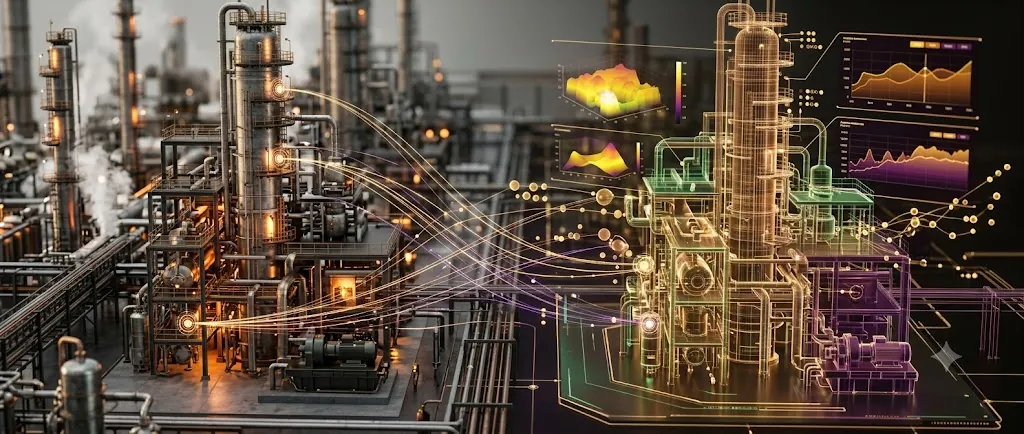
A digital twin is a live, continuously updated digital model of a physical object, system, or process — connected to its real-world counterpart through sensor data, and powered by simulation and AI to predict how the real thing will behave. What started as a concept for monitoring individual machines has grown into a strategy for entire factories, cities, and even the human body.
This guide explains what digital twins actually are, the role of IoT and real-time data in keeping them accurate, where they're delivering value across manufacturing, infrastructure, and healthcare, how AI-driven simulation extends what twins can do, and the practical considerations for organisations evaluating whether and how to build one.
What Is a Digital Twin?
A digital twin is more than a 3D model or simulation — the defining feature is the live connection to its physical counterpart. Sensor data flows continuously from the real object or system into the digital model, keeping it synchronised with the current state of the thing it represents. This is what distinguishes a digital twin from a static design model or a one-time simulation.
Because the digital twin reflects the real-time state of its physical counterpart, it can be used not just to visualise the current state, but to run simulations of potential changes — what happens if this machine runs at higher load, what happens if this traffic pattern changes, what happens if this patient's treatment is adjusted — without affecting the real thing.
The Role of IoT & Real-Time Data
Digital twins depend on the Internet of Things (IoT) — networks of sensors embedded in physical equipment, infrastructure, or environments that continuously measure conditions like temperature, vibration, pressure, location, and usage, and transmit that data to the digital model. The quality and frequency of this sensor data directly determines how accurate and useful the twin is.
Processing this constant stream of sensor data — often from thousands of sensors across a large facility or fleet — requires infrastructure designed for high-volume, real-time data handling. This is one of the reasons digital twins and cloud-native infrastructure are closely linked: the data pipelines, storage, and processing required to keep a digital twin synchronised at scale rely on the same cloud-native patterns used for other large-scale data systems.
Digital Twins in Manufacturing & Operations
Manufacturing is where digital twins have seen the most mature adoption. A digital twin of a production line can simulate the impact of a proposed change — a new piece of equipment, a different production schedule, a process adjustment — before it's implemented on the physical line, reducing the risk and cost of changes that don't work as expected.
Predictive maintenance is another major application: by monitoring the real-time condition of equipment and comparing it against models of normal and degrading performance, digital twins can predict when a component is likely to fail before it actually does — allowing maintenance to be scheduled proactively rather than reactively, reducing unplanned downtime and extending equipment life.
Smart Cities, Infrastructure & Energy
At a larger scale, digital twins are being built for entire pieces of infrastructure — power grids, water systems, transportation networks, and even whole cities. A digital twin of a power grid can model how demand fluctuates, simulate the impact of adding renewable energy sources with variable output, and help operators respond to disruptions more effectively.
City-scale digital twins integrate data from traffic systems, utilities, buildings, and environmental sensors to help planners understand how changes — new developments, infrastructure projects, policy changes — might affect traffic patterns, energy usage, and emissions, before committing to expensive physical changes. These projects are ambitious and long-term, but the underlying pattern — connecting real-time data to a model that can simulate alternatives — is the same as smaller-scale twins.
Digital Twins in Healthcare
In healthcare, digital twin concepts are being explored at multiple scales — from digital twins of medical devices and hospital operations (modelling patient flow, equipment usage, and staffing to improve efficiency) to more ambitious research into personalised digital twins of individual patients, built from their medical history, genetic information, and real-time health data.
The potential of patient-level digital twins is significant — simulating how a specific patient might respond to different treatments before they're administered — but this application is still largely in research and early pilot stages, with significant questions around data privacy, model accuracy, and clinical validation that need to be resolved before widespread clinical use.
AI & Simulation: Predictive Power
AI is what transforms a digital twin from a real-time dashboard into a predictive tool. Machine learning models trained on historical data from the twin can identify patterns that precede failures or inefficiencies, while AI-driven simulation can explore far more scenarios than would be practical to test manually — running thousands of variations of a proposed change to find the ones most likely to succeed.
This combination — real-time data feeding AI models that run simulations and generate predictions — is what allows digital twins to move from describing what's happening now to forecasting what's likely to happen next, and recommending what to do about it. The accuracy of these predictions depends heavily on the quality and completeness of the underlying data, which is why data infrastructure is as important to a digital twin project as the simulation models themselves.
Building a Digital Twin: Implementation Considerations
Starting a digital twin project requires clarity on what question the twin is meant to answer — predictive maintenance, process optimisation, capacity planning — because this determines what data needs to be collected, how the model needs to be built, and what level of fidelity is actually necessary. A twin built for visualisation has very different requirements than one built for predictive simulation.
Most successful digital twin initiatives start with a defined, bounded scope — a single production line, a single building, a single type of equipment — rather than attempting to model an entire facility or organisation from the start. This allows teams to validate the approach, demonstrate value, and refine the data pipeline and models before expanding scope.
Data, Integration & Cost Challenges
The biggest practical challenges in digital twin projects are usually not the simulation or AI components, but the data: integrating sensor data from equipment that may be old and not designed for connectivity, ensuring data quality and consistency across many sensors and sources, and building the infrastructure to handle continuous data streams reliably at scale.
Cost is also a significant factor — instrumenting physical assets with sensors, building and maintaining the data infrastructure, and developing accurate simulation models all require investment that needs to be justified by the value the twin delivers. This is another reason why starting with a bounded, well-defined scope helps: it allows the cost-benefit case to be demonstrated clearly before committing to a larger investment.
The Future of Digital Twins
As IoT sensors become cheaper and more widespread, cloud infrastructure for handling real-time data becomes more accessible, and AI models become better at simulation and prediction, digital twins are likely to become practical for a wider range of applications and organisation sizes — not just large industrial operations with significant capital to invest.
The convergence of digital twins with agentic AI is also an emerging direction — rather than just predicting outcomes, AI agents connected to a digital twin could potentially take action based on what the twin predicts, such as automatically adjusting equipment settings in response to a predicted failure. This remains an emerging capability, but it represents the logical extension of the technologies covered across this series: real-time data, AI prediction, and autonomous action working together.
Conclusion
Digital twins represent a practical application of the broader shift toward connected, data-driven operations — turning real-time sensor data into models that can predict outcomes and simulate alternatives before committing to physical changes. The value is clearest in manufacturing and infrastructure today, with healthcare and city-scale applications still maturing.
For organisations considering a digital twin initiative, the path that works best starts narrow: a single, well-defined use case with clear data availability and a measurable question to answer, building the data infrastructure and validating the approach before expanding to a broader scope.
Ready to explore AI automation for your business?
AtomLeap.ai designs and deploys practical AI workflow systems — built around your existing tools, processes, and operational requirements.
Book a discovery callRelated Articles

Cloud & Infrastructure
Cloud Computing & Cloud-Native Technologies: The Foundation for Modern AI Workloads
Containers, Kubernetes, serverless, and multi-cloud strategy — the infrastructure decisions that determine whether AI workloads scale reliably.
Quantum Computing
Quantum Computing for Business: Separating Hype From Near-Term Reality
What quantum computing can and can't do today, where it's heading, and how to build quantum readiness without overinvesting.
Agentic AI
Agentic AI: Why Autonomous Agents Are Becoming the New Operating Layer for Business
What agentic AI actually is, how multi-agent systems are orchestrated, and the governance practices that keep autonomous systems safe.